Ammonia Storage In Solid State
Although the storage of NH3 in certain salts in the form of amines was known, its implementation has not been widespread, mainly due to the following reasons:
– No need, until now, for such a solution, using its anhydrous form (bottles with NH3 at 10 bar in liquid state).
– Difficulty in handling the NH3 loading processes in the material, given that its volume is doubled.
– Energy required for its extraction in gas form (added losses).
At present, there are factors driving solid-state storage:
– First and by far the SAFE handling of ammonia, given its toxicity, being the critical decision point between methanol (also toxic and in a way NOT AVOIDABLE) and ammonia in the case of shipping. It also affects in a very sensitive way the industry that needs ammonia for its processes that require special facilities and certifications for its handling.
– Transport. Given the characteristic of DECENTRALIZATION in the production of ammonia, bringing it closer to the sources of H2 generation, the transport of NH3 becomes key using safe, high energy concentration and reliable systems.
The use of intermediate systems for the extraction and storage of ammonia in the synthesis reactor has allowed ATD to develop materials for the storage of ammonia in “powder” or “pellets” with the following characteristics:
SAFETY. Totally safe in its handling at pressure and ambient temperature, not releasing ammonia at any time. With this, the material can be transported in conventional tanks without pressure (even plastic) and even “sacks” as if it were grain.
ACCIDENT SAFETY. The material developed:
-Is resistant to direct flame (non-flammable).
-It does not release ammonia even when flooded or spilled into the water, with a very slow, almost imperceptible release, leaving a natural sea salt completely compatible with the nature of the composition of seawater.
Management of volume increase in the loading process. By means of additives and arrangement of the material (patented) it is possible to load the material as well as its circulation (pumping). On the other hand, a reactor-independent loading system has been developed just to store ammonia in solid state from conventional anhydrous ammonia. Extraction.
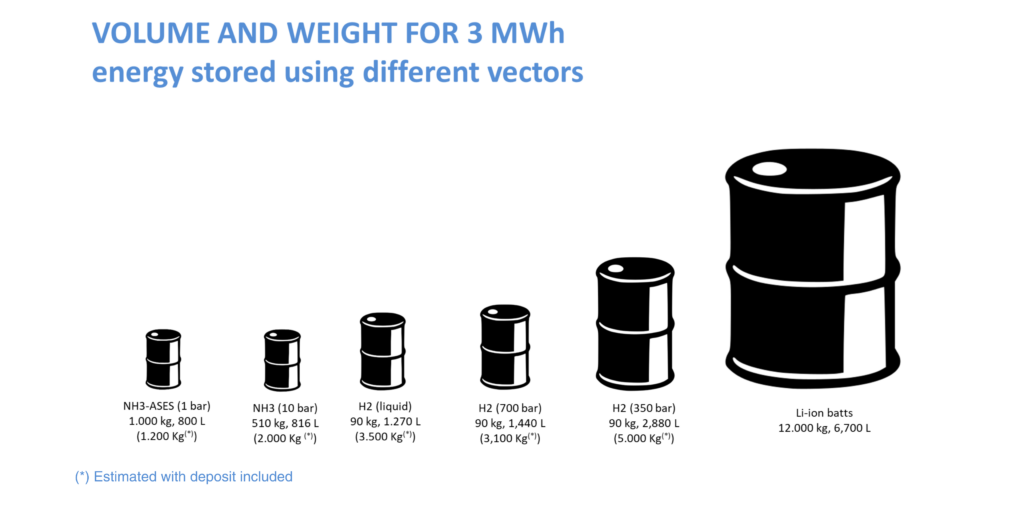
Through a combination of technologies, it has been possible to minimize the energy required for the extraction of ammonia from the solid state material, with losses of less than 15% of the energy content, which is more than justified by the advantages in transportation. Storage density. Between 45% and 50% by weight of pure ammonia contained in the weight of the final solid state material has been achieved. Given that the final density of the material is around 1.25 g/cm3, the total volume is really low to contain a relevant amount of ammonia, as shown in the following figure.
Comparison of volume and weight of different forms of energy storage based on H2. 90 kg of H2 contain approximately 3 MWh of energy. It can be seen that NH3, both anhydrous (bottles at 10 bar) and solid state, occupy less volume than H2 itself in liquid state (cryogenic) or at very high pressures.
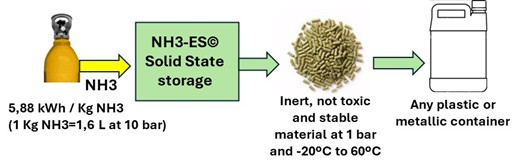
Therefore, the system is ideal for mass energy storage and its transportation and disposal anywhere.
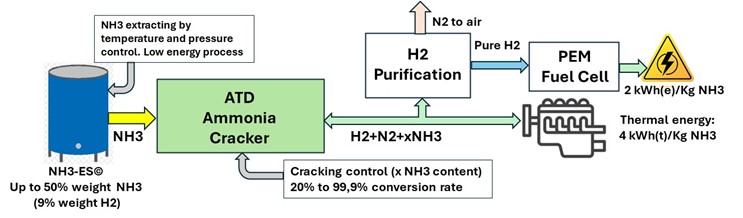
Finally, it should be noted that the solid state material containing ammonia CAN BE OBTAINED DIRECTLY FROM THE SYNTHESIS REACTOR, which is also very energy efficient since the loading process is exothermic and therefore additional energy is obtained by loading the material with ammonia.